Monday, August 10, 2015

Roots

my dad George
One of the reasons I was attracted to go to Cortes Island, BC is because I have roots in the area. Many people on the island would ask me where I was from and I would say "Ontario but my roots are here", and they would give me a puzzled look.

I would explain that my grandfather bought an island in the early 1900s in the Desolation Sound area. It was one of the three Rendezvous islands. He chose the northern one and bought 250 acres for $3000. It is north of Cortes island and only 40 minutes by boat. After my grandfather bought the island, he sent for a picture-bride from Japan, and raised a family on there, including my father George.

My grandfather didn't know that WWII would break out and a government boat would come one day to say that Canada was at war with Japan and they were the enemy. They had one hour to pack their belongings and were taken away to holding stations in Hastings Park in Vancouver and later were moved to an internment camp in the interior. He was told that he would return one day to the island, but he was not allowed to after the war ended and they were released from the camp. Instead, he was given two choices, to go to Japan or go further inland. He chose Japan, believing that Canada did not want him, and returned to the village he was from with his family in tow. He hadn't realized that the village was destroyed during the war and there was nothing for him and his family there. My aunt Helen had married in the camp, and did not return with the family. She eventually ended up in Toronto and worked very hard to save every penny to bring back one family member at a time. That is how my father ended up in Toronto.

George and Suyeko
My mother Suyeko, or Suzie as she was known, has roots in BC too. She was born in Vancouver but her parents died when she was a young girl, and the children were sent to different homes to be taken care of. Suzie was the youngest of five and it was decided that she would be sent to the Japanese back country, or "inaka" as she used to say, to be taken care of by relatives. After the war, my uncle Yosh in Toronto found her and paid for her way back to Canada to be reunited with him and the rest of her siblings.  In her twenties now, she made her way back alone by steam ship to a country where she was born but was forced to leave. George meets Suyeko, and thus I was born in Toronto. 

I have always been pulled to go the west to explore and perhaps stay one day, but I didn't know when or how. This is one of the reasons I jumped at the chance to go to Cortes Island and work at Hollyhock. It would bring me closer to my roots and ancestors, and I have always longed in my heart for this, perhaps it is part of growing older and yearning to know your past.

I took the water taxi back to Cortes from Campbell River recently, and the owner-driver Regent said he remembered driving my relatives to the northern Rendez-vous island some 15 years ago. I told Regent I wasn't on that trip because the elders in the family, my father and aunt Helen, didn't want to go, and thus I decided not to go too, thinking that I could encourage my dad to return with me one day. I didn't want to go without him. My dad and aunt have now passed on and I could never encourage them to go with me. The youngest siblings, my aunt Joy and uncle Arthur, and their children went and reported back. They said that the resort that had been built there welcomed them and they explored the land with my aunt and uncle, who were young kids when they left and had fond memories of their time there.

With the visit of the Ishii clan to the island, some locals asked the government to change the name of the tip/cove where they settled to "Ishii" in honour of my grandparents. Regent said it had been changed on the newer maps. He said that the people who owned the resort then, sold it, and moved on and the land is divided up more.

He pointed to the map where the island was and then pointed in the direction of some mountainous areas in the distant. "That's the island over there," he said. I felt excited to be in the area that my grandfather had fallen in love with and to know that he had travelled and fished in these waters with my father George and his brothers, there were three and one that died and is buried on the island. The girls, there were two, stayed at home, helping their mom with the farmland and preparing lots of food to store in the cellar for the winter.

It's not as easy as I had originally thought to go to northern Rendez-vous island, although it's only forty minutes by boat from Cortes Island. But again, I found in being on the island and not from the island, many things were challenging. You either have to pay quite a bit to charter a boat or know someone with a boat. In a comforting way, I felt the presence of my ancestors and my roots, and that was enough for now.

The northern Rendez-vous island is in the distance to the left


When my relatives visited northern Rendez-vous island, the locals said there was a strange weed growing all over the island and they couldn't get rid of it. My aunt Tomo told them that it wasn't a weed but a Japanese vegetable called "fuki" and gave them instructions on how to cook it. My grandfather and grandmother had orchards and farmland so they could be self-sufficient, and this must have been one of the vegetables that they grew to give them a "taste" of Japan.

We leave roots in many ways when we leave a place that we love, and sometimes it's of the physical you can eat kind. It makes sense that my family who loved to cook, eat, and most of all share food, left something behind for others to eat. However, it would take some 60 years for others to discover it.

Image result for fuki vegetable
Fuki


Monday, August 3, 2015

Food evolution

More photos of the dishes I created in the kitchen at Hollyhock centre on Cortes Island, BC and the beautiful English-inspired garden. Food is served buffet-style, often for 100 or more guests, with a short period to prepare and serve guests, often with a small kitchen team of varying skills. To keep the beauty and essence of the dish throughout service remains a challenge, but the taste, nourishment and love remains relatively the same.

Everything is changing all the time, you, me, the garden, the world, so why not a dish, evolving with each person that eats it? And instead of fighting it, of thinking my food would be more beautiful if plated, taste better only if I had a certain ingredient I can't get, and wishing I had more time and staff, I try to control the only thing I can, the present moment, breathe into it, and let go. Yoga practice has helped me a lot in cooking and in life. I learn every day from my cooking, and it's often not about the food. Food for thought.


Thursday, July 30, 2015

Emotional suitcase

More good wifi, more food shots to share. Who knew that a perfect pairing with good food would be wifi? It's not a given here, nothing much is, you can't expect the things that I have been accustomed to at home like reliable internet and cell phone coverage, a transportation system, stores to buy things at if you need something, services like a hair salon or health related services like a dentist, doctor or acupuncturist.

It's been great in some ways to help me save money because there is no where to spend it, and at the same frustrating to get basic things done like get your hair cut. How do people do it on the island? Well, there are a lot of women and men with long hair here, they find friends to help them for the most part or get it done when they get to the "mainland".

It's been a good lesson for me about what's important to me, what matters most, and it's sometimes not what I had thought. I encourage you to get away and have this kind of experience, even for a short period, or at least imagine it in your mind. What would be really important for you to have, what is a want, what is a real need? If you only had one suitcase to bring for several months what would be in it? If you were on an island like this, what would you miss most?

Everyone is different. For me, as soon as I got to the ferry terminal at Nanaimo, on my way for my quick getaway to Vancouver for a few days, I saw a Starbucks and had to get a latte. I wanted it. I did not need it of course, but it nourished me in so many ways. I have a lot of good memories at coffee shops. This is where I meet friends, go for a break during a busy day, and where wrote a lot of my book.

We eat with so many senses besides our taste buds, and it nourishes us in countless ways. Many times here, I've had presenters and guests tell me that they love my food, that they can feel the love and care I put into the food, they can taste the difference. And this makes me very happy, that I can transmit love to others through my food, thereby nourishing their bodies and souls, and in turn nourishing me. That's one of the intangible but important things that I need. It's in my emotional suitcase, the one that I brought with me and didn't have to pay extra for to check-in.

A few more photos to share, mostly of food, one of a cooking class on Japanese cuisine that I held in our kitchen..

Photo descriptors of the food, all vegetarian, and mostly vegan and gluten-free, with as much from the garden as possible, including the flowers, which are edible:

-Carrot-walnut cake with cream frosting, chocolate drizzle
-Cauliflower and pomegranate
-Garden veg with sesame dressing
-Garlic scape-zucchini bake
-Making garam masala for curry
-Rice-lentil pilaf
-Spinach mountains
-Pasta bake
-Yaki manju with red bean
-Cooking class on Japanese cuisine as part of the farm-to-table program
-Rhubarb-berry crisp
-Watermelon feta salad
-Green beans and rainbow chard
-Butter with lemon and garden herbs and blossoms
-Cilantro hot sauce
-Roasted beet salad
-Shepherd's pie
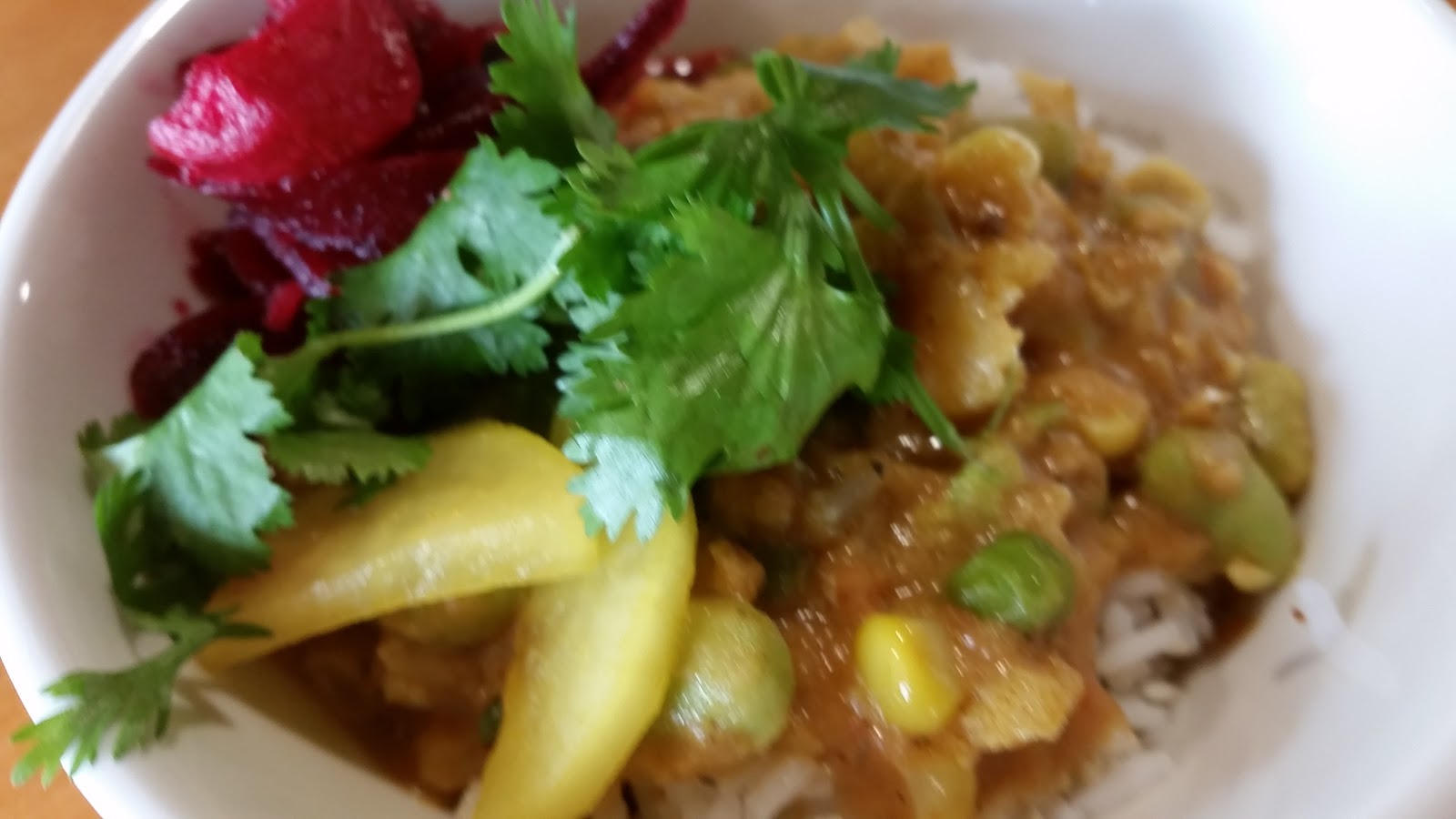
-Indian curry with yellow daikon and red beet pickles
-Coconut cake